59% of AEC firms faced a cybersecurity threat in two years. A takeoff tool asks for the whole set.
Most AEC firms have met a cybersecurity threat in the past two years, and most cannot work for long without their documents. LumenTakeoff opens, reads and counts the plan set on the estimator's own machine, so no drawing content leaves the building.
The figure
59% of architecture, engineering and construction firms faced a cybersecurity threat in the last two years. Among general contractors, 30% have had a ransomware attack since 2021.
Source: Egnyte and Dodge Construction Network, Data Resilience in the AEC Industry, 2023
Egnyte and Dodge Construction Network published a study in 2023 called Data Resilience in the AEC Industry. In it, 59 percent of architecture, engineering and construction firms reported facing a cybersecurity threat in the previous two years. Among general contractors, 30 percent had a ransomware attack since 2021. The same study found that 77 percent of firms cannot go more than five days without access to their documents before schedules start to suffer.
I am 18, I work in electrical preconstruction, and I count lighting fixtures by hand. When I read that study I did not think about firewalls. I thought about what a takeoff tool asks a contractor to hand over.
A plan set is not an anonymous pile of geometry. The title block on every sheet carries the owner, the architect and the street address. E-001 carries the fixture schedule, which is most of the lighting specification. The sheet index tells you how big the job is. Now put that set on bid week, when three other contractors are pricing the same drawings, and consider that the normal way to use a cloud takeoff tool is to upload all of it to a server you do not control, under an account you did not audit, on the one date that matters.
This is rarely the estimator's call alone, either. Most firms have a rule about which tools may see bid documents, written down or not, and it is usually stricter than the software assumes.
What LumenTakeoff does about it
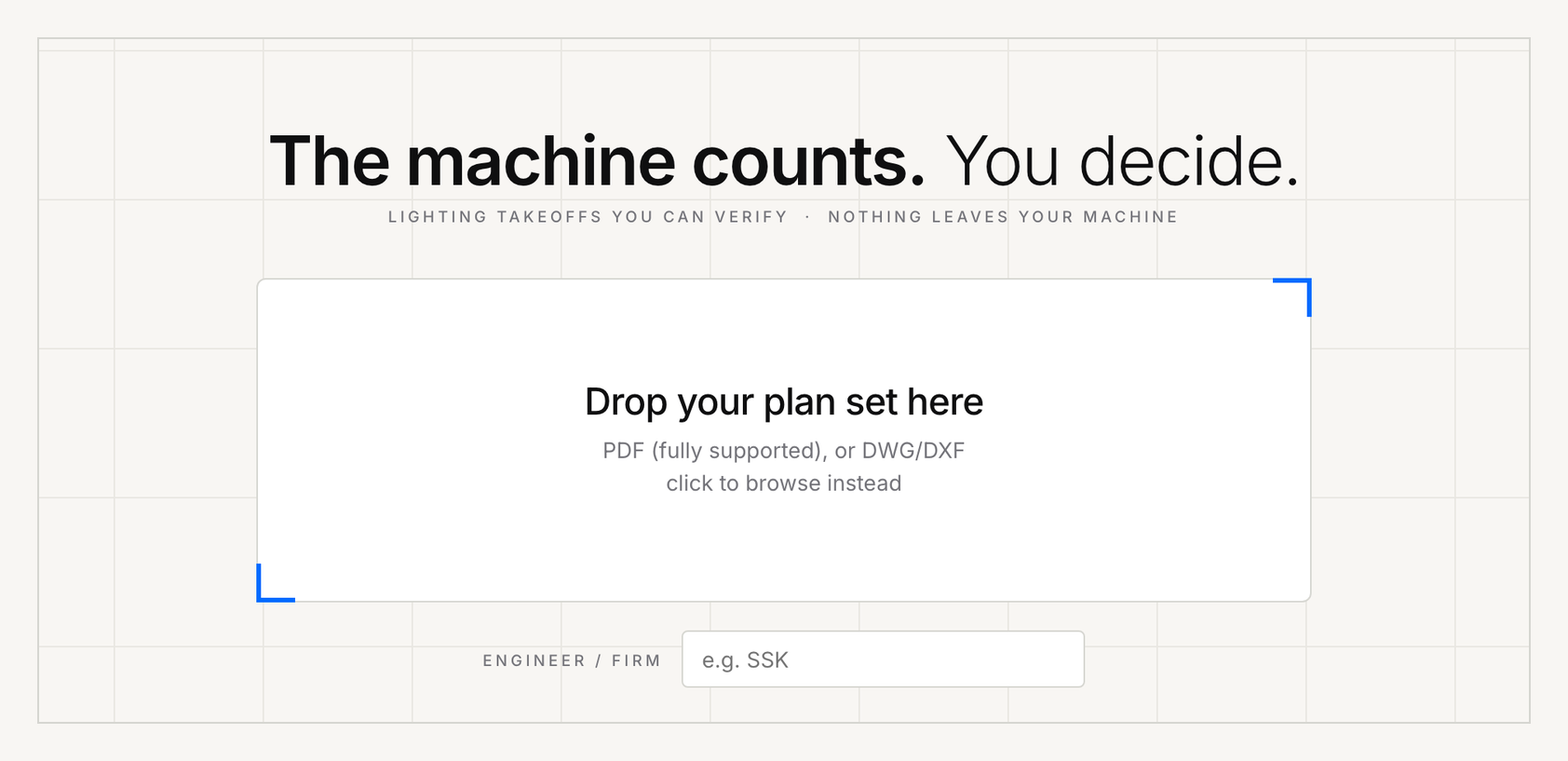
LumenTakeoff runs on the estimator's machine. You drop the PDF on the drop screen and it is opened, read and counted locally. A full multi-discipline set is fine, and a 64-page set processes in about a minute, page by page, with progress showing. No drawing content leaves the machine. There is no upload step, because there is nothing to upload to.
The firm's library of confirmed names lives on that same machine, scoped to the firm. When you confirm that a symbol is a Type A1, the decision is written locally, and it is there the next time a set arrives from the same engineer. Nothing about your past jobs sits in a vendor's database. There is no account on a server holding your bid documents, because there is no server.
The rest follows from that. There is no metered AI and no per-sheet fee, because no sheet is being sent anywhere to be metered. Ask the plan, which answers questions from the sheet's text, the schedule rows and the engine's counts, uses a local model. Pages that are scanned or raster are reported as unsupported rather than guessed at, and that report happens on your machine too.
This is the part of the product I find easiest to explain to anyone who has been through an incident. The machine counts. You decide. And the drawings stay in the building they arrived in.
The machine counts. You decide.
Bring a plan set
See what LumenTakeoff finds.
Run a real lighting takeoff and review the result against the way your team works today.
- Supported vector plan sets
- Lighting fixture families and counts
- Evidence you can check against the drawing
Built for electrical estimators. Your address is used to reply about LumenTakeoff and nothing else.