62% of construction firms run estimating on spreadsheets, so the takeoff should arrive as one.
JBKnowledge found estimating to be the construction workflow most likely to live in a spreadsheet, ahead of accounting and bid management. LumenTakeoff treats that as the destination rather than the problem, so Lock in produces one XLSX with Coverage, Quantities, Findings and Evidence sheets.
The figure
62% of construction firms run estimating on spreadsheets instead of estimating software.
Source: JBKnowledge, 9th Annual Construction Technology Report, 2021
JBKnowledge's 9th Annual Construction Technology Report found estimating to be the workflow most likely to live in a spreadsheet. 62 percent of firms run it that way rather than in estimating software, ahead of accounting and ahead of bid management. Takeoff itself sat at 27 percent.
Most takeoff tools treat that as the problem to be fixed. Move off the spreadsheet, into the platform, and learn a new way of doing the job. I do not think the spreadsheet is the problem. The spreadsheet is where the pricing actually lives: the labour units, the assemblies, the adjustments a senior estimator makes without writing down why, the tab that has been carried from job to job for nine years. The estimator knows it cold.
Asking someone to give that up on bid week, in exchange for a count they cannot check, is how a good tool gets opened once and never opened again.
So the question I asked myself was not how to replace the spreadsheet. It was what shape a fixture count has to arrive in for the sheet that prices the job to simply absorb it.
What LumenTakeoff does about it
LumenTakeoff's output is a spreadsheet. Lock in produces one XLSX with four sheets. Coverage says which pages were counted, which were out of scope and which were unsupported. Quantities is one row per fixture family with its scope state. Findings is what still needs a look. Evidence records where every number came from. Alongside it come proof images with every counted instance ringed on its own sheet.
Nothing in that asks the team to move. The XLSX drops in next to the pricing sheet the firm already uses, and the figures that matter downstream stay separate instead of blended: detected instances, production count, in bid scope, exact signatures, and how many times the schedule tag appears on the sheet, shown as a document-stated figure with its discrepancy. A reconciliation check runs before the file is written, and if the counts do not reconcile the export is refused rather than handed over.
The naming can happen in Excel too, which is now the part estimators ask about first. Download the offline naming sheet and it is an ordinary Excel file with the symbol crops embedded and the set's schedule codes on a second tab. Fill in the type codes wherever you like, upload it back, and each confirmed name applies to every signature in its family and is written to the firm's library for the next set from that engineer.
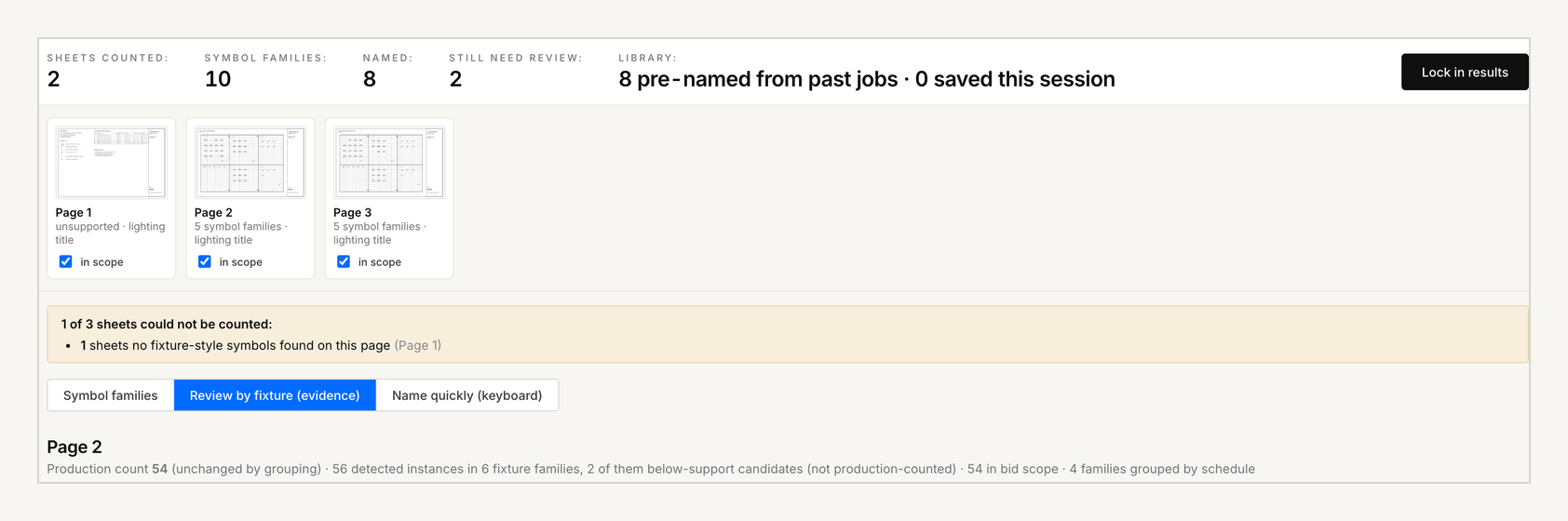
On screen the same figures are visible before anything is exported. The page summary reads production count 54, unchanged by grouping, 56 detected instances across 6 fixture families, 54 in bid scope. Three numbers, none of them collapsed into the others, because a total is the one form in which two opposite errors cancel and look correct.
62 percent is not a figure about backwardness. It is a statement about where the work is really done. A takeoff tool should hand the numbers to the estimator in the format the estimate already lives in, and then get out of the way.
The machine counts. You decide.
Bring a plan set
See what LumenTakeoff finds.
Run a real lighting takeoff and review the result against the way your team works today.
- Supported vector plan sets
- Lighting fixture families and counts
- Evidence you can check against the drawing
Built for electrical estimators. Your address is used to reply about LumenTakeoff and nothing else.