59% of AEC firms faced a cybersecurity threat in two years. A plan set is a bid document.
Most AEC firms have met a cybersecurity threat in the past two years, and the first thing a takeoff tool asks for is the entire bid set. LumenTakeoff opens, reads and counts the PDF on the estimator's own machine, so no drawing content leaves the building.
The figure
59% of architecture, engineering and construction firms experienced a cybersecurity threat in the last two years. Among general contractors, 30% have had a ransomware attack since 2021.
Source: Egnyte and Dodge Construction Network, Data Resilience in the AEC Industry, 2023
Egnyte and Dodge Construction Network looked at data resilience across the architecture, engineering and construction industry in 2023. Fifty-nine percent of firms had experienced a cybersecurity threat in the previous two years. Among general contractors, 30 percent had been through a ransomware attack since 2021. In the same study, 77 percent of firms said they could not go more than five days without access to their documents before the schedule began to suffer.
Those findings usually get filed under IT, two floors from the people who actually handle the drawings. Then estimating is asked to upload a plan set.
I am 18, I work in electrical preconstruction, and I count lighting fixtures by hand, which makes me the person most likely to be handed a new tool to try. So look at what a takeoff tool asks for on bid week. The full set. That means the owner's name, the site address, the scope you are pricing against three other contractors, and the engineer's drawings, all handed to a server you do not control. A plan set is not just geometry. It is the shape of your number before anyone else has it.
The usual reassurance is a page about encryption at rest. That is a promise about how carefully somebody else holds your bid documents. It is a different thing from your bid documents never leaving the building.
What LumenTakeoff does about it
LumenTakeoff runs on the estimator's machine. You drop the PDF on the first screen and it is opened, read and counted locally. A 64 page multi-discipline set processes in about a minute, page by page with progress showing. No drawing content leaves the machine, because there is nowhere for it to go.
The sheet strip lists every page in the set with a checkbox for in scope, so architectural and mechanical sheets get unticked before anything is counted. Pages that are scanned or raster are reported as unsupported rather than guessed at. A tool that will not quietly guess at a page it cannot read is also a tool that will not quietly send that page somewhere to be read.
The firm's library of confirmed names lives on the same machine, scoped to the firm. When an estimator confirms that a particular engineer's circle with a slash is a Type A1, that decision is written locally, and the next set from that engineer arrives partly pre-named, as evidence for whoever is at the desk to accept or override. The library compounds across jobs without a copy of your past bids sitting on anybody's server.
No account holds your drawings. There is no metered AI call per sheet and no per-sheet fee, because the counting is deterministic on supported vector sheets and happens where the file already is. It is in the demo phase, tested against real electrical plan sets.
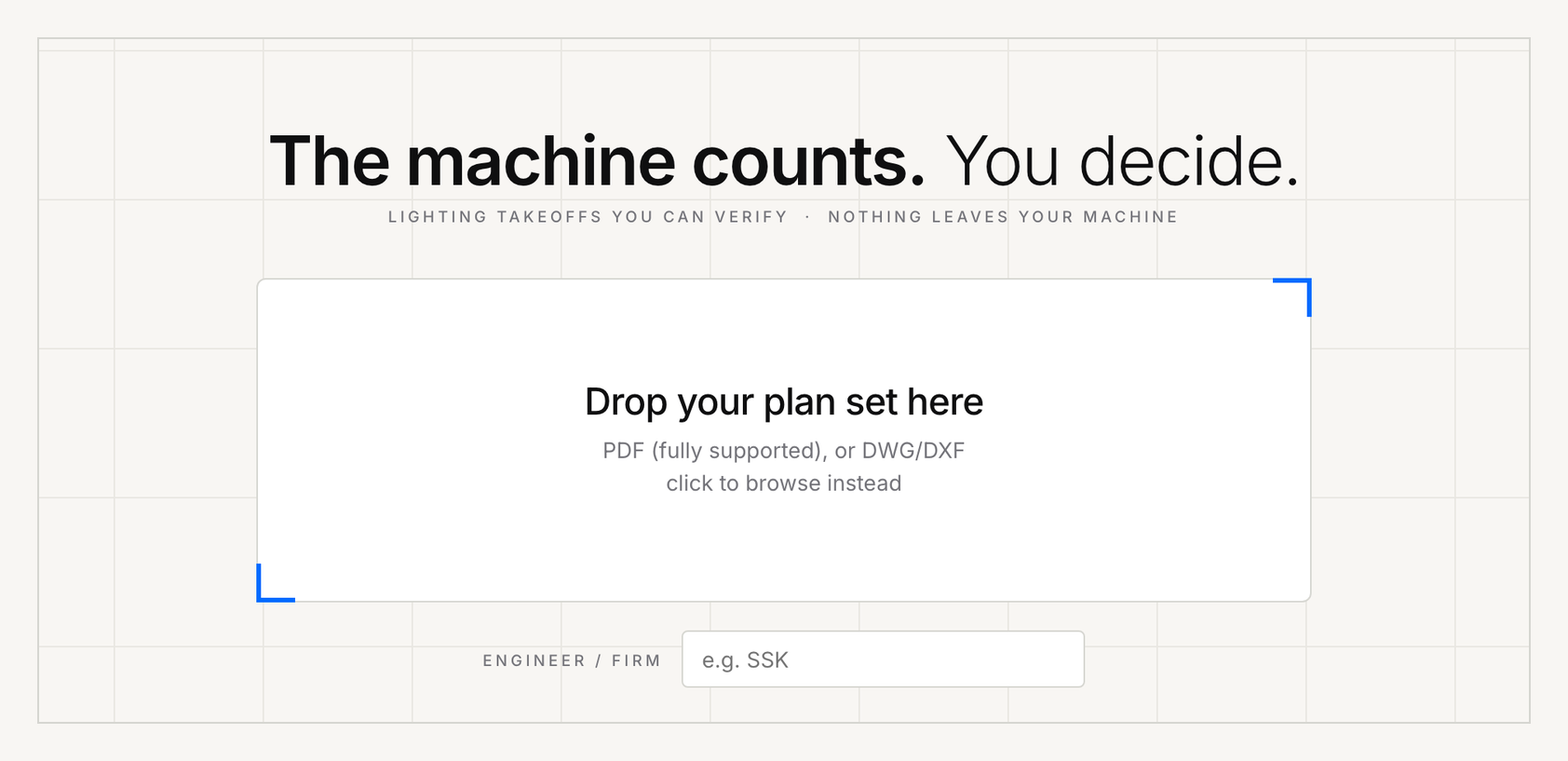
The machine counts. You decide.
The machine counts. You decide.
Bring a plan set
See what LumenTakeoff finds.
Run a real lighting takeoff and review the result against the way your team works today.
- Supported vector plan sets
- Lighting fixture families and counts
- Evidence you can check against the drawing
Built for electrical estimators. Your address is used to reply about LumenTakeoff and nothing else.