Only 22 per cent of US contractors said they could generate decision-ready information within hours.
CMiC and Dodge Construction Network found that only 22 per cent of US contractors could generate decision-ready information within hours, and on bid day a lighting count is exactly that kind of information. LumenTakeoff runs a reconciliation check before Lock in results and refuses to export a wrong number, then hands over an XLSX and proof images with every counted instance ringed.
The figure
Only 22 per cent said they could generate decision-ready information within hours.
Source: CMiC and Dodge Construction Network, Optimizing Project Controls for Contractors, 2026
CMiC and Dodge Construction Network surveyed 301 US contractors, general and specialty, working on non-residential projects, for their 2026 brief Optimizing Project Controls for Contractors. Only 22 per cent said they could generate decision-ready information within hours.
That brief is about project controls, cost and schedule across a whole job. My desk is a lot smaller than that. But on bid day, a lighting count is decision-ready information too. The PM wants one number per fixture type, they want to be able to trust it, and they want it before the bid goes out, not after.
I'm 18 and I count these by hand. The worst moment is not the counting. It's when the total on my sheet and the total I remember don't match, and the bid is due at 2. Was that cluster on E-2.1 a Type F or an F1? Did I count the corridor on both sides of the match line? There is no fast way to find out, so the choice is a recount nobody has time for or a number nobody can defend.
A number is not decision-ready when it appears. It is decision-ready when someone can check it.
What LumenTakeoff does about it
LumenTakeoff runs a reconciliation check before Lock in results. If the numbers don't reconcile, export is refused rather than exporting a wrong number. I would rather the tool stop me at 1:40 than hand me a clean-looking file that is wrong.
When they do reconcile, Lock in produces one XLSX with four sheets. Coverage says which pages were counted, which were out of scope and which were reported as unsupported. Quantities is one row per fixture family with its scope state. Findings is what still needs a look. Evidence records where every number came from. Alongside it come proof images with every counted instance ringed on its own sheet, so the PM can check a figure without walking over to ask me.
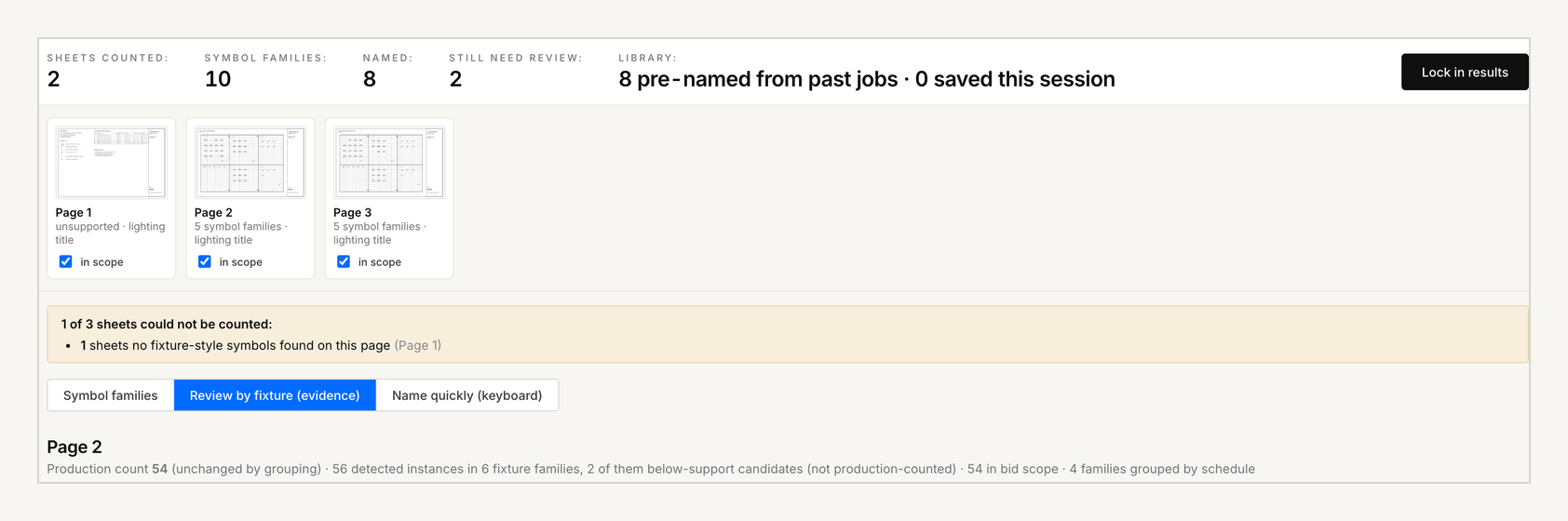
Before any of that, the page summary keeps the figures apart. Production count, which is the exact-signature count and stays unchanged by grouping. Detected instances. In bid scope. On the screen in the picture that reads production count 54, 56 detected instances in 6 fixture families, 54 in bid scope. 54 and 56 never blur into one number, because if two figures differ, I want to see why before the bid goes out.
Scope is shown with its evidence too. Existing to remain, relocated, demolition and unresolved are held apart from new work, and where the drawing does not settle it, the family is flagged rather than assumed. Everything is reported per fixture type, never only as a total, because opposite errors cancel in a total and look correct.
The count is deterministic on supported vector sheets, scanned pages are reported as unsupported and never guessed, and all of it runs on the estimator's own machine. What it hands over is a number with its evidence attached, which is the only kind I would call decision-ready.
The machine counts. You decide.
The machine counts. You decide.
See how electrical takeoff works in LumenTakeoff, or lighting takeoff software for fixture counts from PDF plans.
Bring a plan set
See what LumenTakeoff finds.
Run a real lighting takeoff and review the result against the way your team works today.
- Supported vector plan sets
- Lighting fixture families and counts
- Evidence you can check against the drawing
Built for electrical estimators. Your address is used to reply about LumenTakeoff and nothing else.